Identity and access
We review users, roles, privileged access, old accounts, shared accounts, vendor access and joiner and leaver steps.

Cyber Hygiene & Compliance
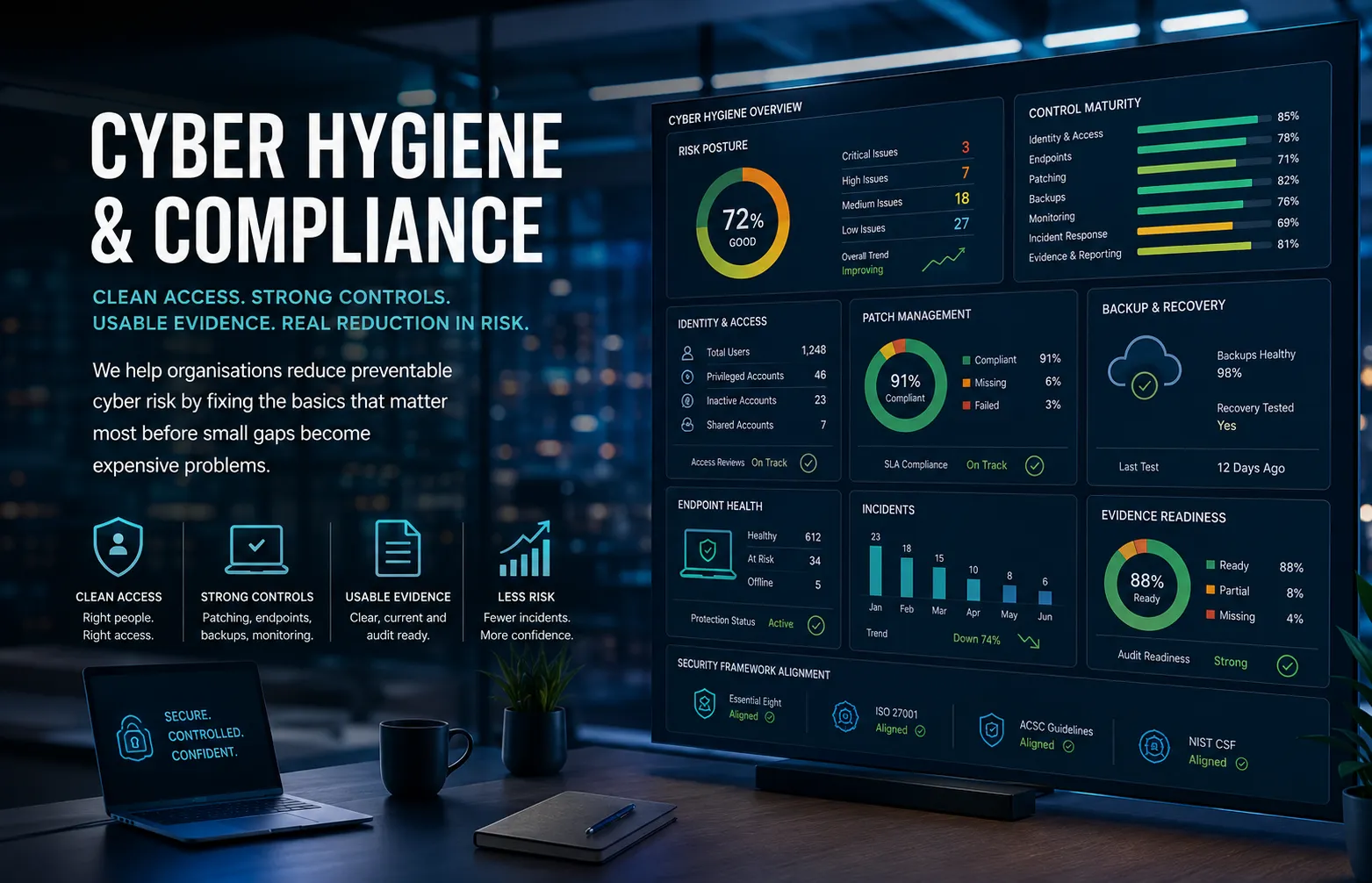
GCT helps organisations reduce preventable cyber risk by cleaning up access, patching, backups, endpoint controls, evidence and ownership before small gaps become expensive.
The real risk
Most preventable cyber risk starts with normal business drift. People leave. Access stays. Devices miss patches. Backups are assumed to work. Evidence lives in different places. Alerts create noise, but not enough decisions.
Compliance pressure then arrives and the organisation has to prove control quickly. That is when small gaps become expensive.
Leaders who want fewer preventable cyber issues, clearer ownership and better evidence without turning security into theatre.
Based in Sydney. Remote delivery available for organisations in Australia and overseas where the scope, timing and fit make sense.
Call GCT when security is not completely broken, but too much depends on trust, memory, manual checks or scattered evidence.
What we review
We review the practical cyber hygiene controls that make security easier to prove, easier to maintain and harder to ignore.
We review users, roles, privileged access, old accounts, shared accounts, vendor access and joiner and leaver steps.
We check device visibility, protection, patch status, baseline controls and where endpoint gaps may create avoidable risk.
We look at patch ownership, reporting, exceptions, timing and whether the business can explain what is missing and why.
We review backup coverage, recovery testing, ownership and whether the business can recover cleanly under pressure.
We check whether cyber evidence is clear, current, reusable and easy to produce for leadership, insurers, customers or audits.
We review alerts, ownership, escalation paths and whether monitoring creates decisions instead of more noise.
What you receive
The output is designed to help leaders make clear decisions. What is weak. What matters. What to fix first. Who owns it. What evidence is missing.
A clear view of the highest-risk access, endpoint, patching, backup, monitoring and evidence gaps.
Practical findings around privileged access, old accounts, shared accounts, vendor access and unclear ownership.
A plain list of what evidence exists, what is missing, what needs updating and what should be easier to produce.
A staged action plan showing what to fix first, what can wait, what needs ownership and what should not be ignored.
A practical view of who should own access, patching, backup testing, monitoring, evidence and exceptions.
Clear options for a small uplift, deeper review, evidence clean-up, operational support or vendor discussion.
How it works
We clarify the business pressure, known cyber issues, audit needs, customer requirements and current constraints.
We review current records, policies, reports, access evidence, patching evidence, backup evidence and ownership.
We identify the weak points creating cyber exposure, audit friction, customer risk or operational noise.
You receive a practical 30 to 90 day plan with priorities, ownership and evidence actions.
Recommended starting point
Start with the Operational Reality Snapshot. It gives leadership a clear view of hidden operational, data, IT, cyber and AI readiness gaps before those gaps become expensive.
Related services
If the review finds weak systems, unclear data, AI readiness gaps or document-heavy evidence work, these GCT services can support the next step.
Stabilise systems, access, cloud, endpoints, backups and operating controls before AI adoption adds more pressure.
Assess whether data, workflows, cyber access and ownership are ready before AI is scaled across the business.
Extract, validate and route information from documents, forms and PDFs with fewer manual steps.
Automate workflows around real work, clear ownership, validation and escalation.
Customer-facing AI assistants with clear scope, safe boundaries and human escalation.
A practical starting point to find hidden operational, data, IT, cyber and AI readiness gaps before they become expensive.
FAQ
If access, patching, backups, endpoints and evidence are unclear, the business is relying on luck. That is not a control.